


Malaysia’s role in Southeast Asia’s games industry growth
Southeast Asia is a fast-growing region for the games industry. Niko Partners estimates that there are more than 300 million gamers in the six countries we track in SEA: Indonesia, Malaysia, Philippines, Singapore, Thailand, and Vietnam. Across these markets, total PC and mobile game revenue is anticipated to reach USD6.5 billion by 2025, with an estimated CAGR of 7.1% for 2021-25 (Niko Partners, 2023). The game industry’s size encompasses revenue from various sectors including in-game purchases, game development and esports.
Niko Partners conducts an annual survey of 2,400 gamers in Southeast Asia, primarily targeting Gen Z and Millennials aged 18 to 29. Whether for casual fun or competitive action, gaming has become an integral part of Southeast Asian culture. Esports, in particular, have emerged as a significant component of mainstream entertainment in the region.
Esports was included as a medal title for the first time at the Olympic Council of Asia (OCA), sanctioned Southeast Asian Games (SEA Games) in the Philippines in 2019, followed by the 2021 SEA Games in Vietnam and the 2023 SEA Games in Cambodia. Singapore also hosted the first Olympic Esports Week in 2023.
The region boasts prominent esports organizations, such as EVOS Esports, Team Flash, Fnatic and ONIC Esports. Southeast Asian countries have also served as the host location for major global tournaments such as the Free Fire World Series and the Mobile Legends: Bang Bang World Championships, which have taken place in SEA for 5 years consecutively.
Malaysia’s policies for games and esports industry development
The growth of esports and gaming in Southeast Asia is inspiring increased attention and investment, and Malaysia is one of the leading markets in the region, taking an active role incentivizing this growth. Game industry stakeholders, including the government, telco companies, and other tech organizations, are taking initiatives in providing programs to nurture games and esports talent. Malaysian government agencies, particularly the Malaysia Digital Economy Corporation (MDEC), have also provided incentives and support to game creators, encouraging more to start and grow game development companies. Programs such as the Digital Content Grant, Digital Content Creators Challenge, and the Pemangkin IP360 Metaverse initiative are key examples of initiatives encouraging development.

As for esports, the Malaysian government has shown its support, with the Sports Development Act 1997 amended to include recognition for esports last year. Youth and Sports Minister Hannah Yeoh and the government-led Esports Integrated (ESI) also launched the National Esports Development Guidelines (NESDEG). NESDEG is one of the first government guidelines in the region to provide detailed protections for esports players and guidance for esports tournament organizers.
In October 2023, Malaysia’s Ministry of Finance announced a MYR 30 million (USD6.3 million) budget to encourage foreign games and esports companies to invest in Malaysia. While detailed information about the budget allocation is not yet available, this initiative is expected to enhance Malaysia’s appeal to foreign companies considering to enter the market.
Why the games and esports industry are important to support
In analyzing the support for gaming and esports in Southeast Asia, including Malaysia, it is important to consider the market context. The younger generations, particularly Gen Z and Gen Alpha, are growing up in a digital-first world.
This environment requires a different set of skills compared to previous generations. Essential skills for thriving in this digital-first world include digital communication, collaboration, creativity, critical thinking, and problem solving. Notably, these skills can be nurtured through video games (Bailey, et al., 2006). (Hewett, 2022).
Video games and esports encourage competence in these skills in an engaging format. For example, multiplayer video games and esports can enhance communication and collaboration skills through their team-based aspects (Musick, et al., 2021). Furthermore, creativity, critical thinking, and problem-solving can be fostered through game development activities (Thomas & Greene, 2011) and by playing certain game genres, such as strategy and role-playing games (Franco, et al., 2019).
Second, the development of video games and esports industries unlocks new job opportunities locally and beyond. Opportunities in the games and esports industry include being a game developer, professional esports player, esports coach, and content creator. The demand for esports in the region also leads to an increase in prize pools across esports tournaments. Jianwei Yap, a Malaysian Dota 2 player, has earned USD2,081,585 from prize pools alone (Esports Earnings, 2024), which is the highest earning among all players in Southeast Asia.
In Malaysia’s case, the country has seen an increased number of game studios that can develop AAA games. Studios such as Lemon Sky Studios, Passion Republic, Streamline Studios, Common Extract and Kaigan Games are taking part in bringing Malaysian game developers precious experience in developing successful games. Notable games that are developed with the involvement of Malaysian studios include Street Fighter 6, Final Fantasy XV, Cyberpunk 2077, Death Stranding, Spider-Man Remastered, The Last of Us: Part 2, Elden Ring, Street Fighter 6, and Overwatch 2. The quality of Malaysian studios is also attracting foreign investments, with Lemon Sky Studios acquired by Australia-listed game developer iCandy Interactive for USD30 million, while Common Extract was acquired by Swedish studio The Gang for an undisclosed amount.
Malaysia has made significant breakthroughs in the esports industry. AirAsia, a Malaysian-based low-cost airline, became the first airline in the world to own an esports team, actively developing the esports scene in the country and the region before the COVID-19 pandemic. In addition, Malaysia’s Esports Business Network (EBN) operates EBN Esports City in Kuala Lumpur, the largest esports facility in Southeast Asia, spanning over 6,000 square meters and accommodating more than 1,000 people. Another noteworthy development is the creation of a Mobile Legends-focused Esports Hub at Hatten Land’s Element X mall in Melaka, the first of its kind globally.
These initiatives demonstrate Malaysia’s potential to enhance its international reputation, nurture local talent, and boost the domestic popularity of esports. Supporting the video games and esports industry can lead to positive outcomes, including developing essential skills and creating job opportunities.
Challenges to the growth
Despite all the developments supporting the growth of video games and esports industries in the region, particularly Malaysia, we acknowledge that challenges remain. First, there is rising job insecurity in the global games industry, as shown by layoffs over the past one to two years. These layoffs are largely due to overstaffing during the pandemic, based on overly optimistic expectations of games industry growth. As growth has returned to a more regular pace, companies have had to reduce staffing. This has also been paired with increasing costs for talent across the industry, with inflation and cost of living adjustments being a partial factor.
Second, older people across the region, including Malaysia (Osman & Bakar, 2012) (Ng, 2023), are skeptical about video games and esports. Video games and esports are often seen as having negative impacts on children, causing addiction, bad behaviour and poor social skills. Generational attitudes like these will take time to change.
Third, expertise and experience regarding games and esports are still lacking. While a vibrant game development and esports scene has emerged in the last decade, the region is still far behind the games industry giants of China, Japan, and South Korea (Tiwari & Grace, 2023).
In Malaysia, in particular, we have seen investments and businesses opening in the country that are propelling the growth of the games industry, as opposed to the mass layoffs and issues plaguing the games industry on the global scene. For example, US-based game commerce and payment company Xsolla opened a new office in Kuala Lumpur in 2023, making it one of the company’s largest offices. UK-based game developer and publisher Double Eleven also opened a studio in Kuala Lumpur in 2022, drawn by the talent that Malaysian developers provide.
However, it does not mean that there are no problems within the country’s games industry. For example, there are still issues, such as the harassment scandal that hit Persona Theory Games studio (Virtual SEA, 2024) and there are opinions from local muftis (Muslim legal experts) that think some games are haram (prohibited for Muslims).
For these reasons, government entities and games industry stakeholders need to collaborate further to ensure future policy formulation, incentives, and protections are put in place to support the growth and safety of the games and esports industry. More actions are also needed to inform the public on the positive sides of games and how to curb potential negative impacts.
Future outlook
Southeast Asia’s games and esports industry, including Malaysia, has continued to grow in recent years. Malaysia’s games industry has grown on average by 8.9% YoY since 2020 (Niko Partners, 2023) and since 2020, Niko Partners has also estimated that more than 50% of Malaysia’s population are active gamers.
There are many reasons to be optimistic about these trends. Malaysia has the potential to lead the games industry growth in the region as the country boasts a favorable business environment for game companies.
This includes talented and world-class game developers, a growing popularity among foreign game companies developing regional offices due to Malaysia’s supportive business environment, a significant increase in digital economy investments, and growing recognition and support for esports within private and government sectors.
By Darang S. Candra (Director for Southeast Asia and East Asia Research)
 This article is part of Horizon : A Perspective of Malaysia’s Digital Economy, a strategic digital economy publication published by Malaysia Digital Economy Corporation (MDEC). The article is reproduced with permission. See the full publication here.

Niko Partners Vice President Xiaofeng Zeng reflected on his observations of ChinaJoy in this new blog post. Niko Partners has Learn more >
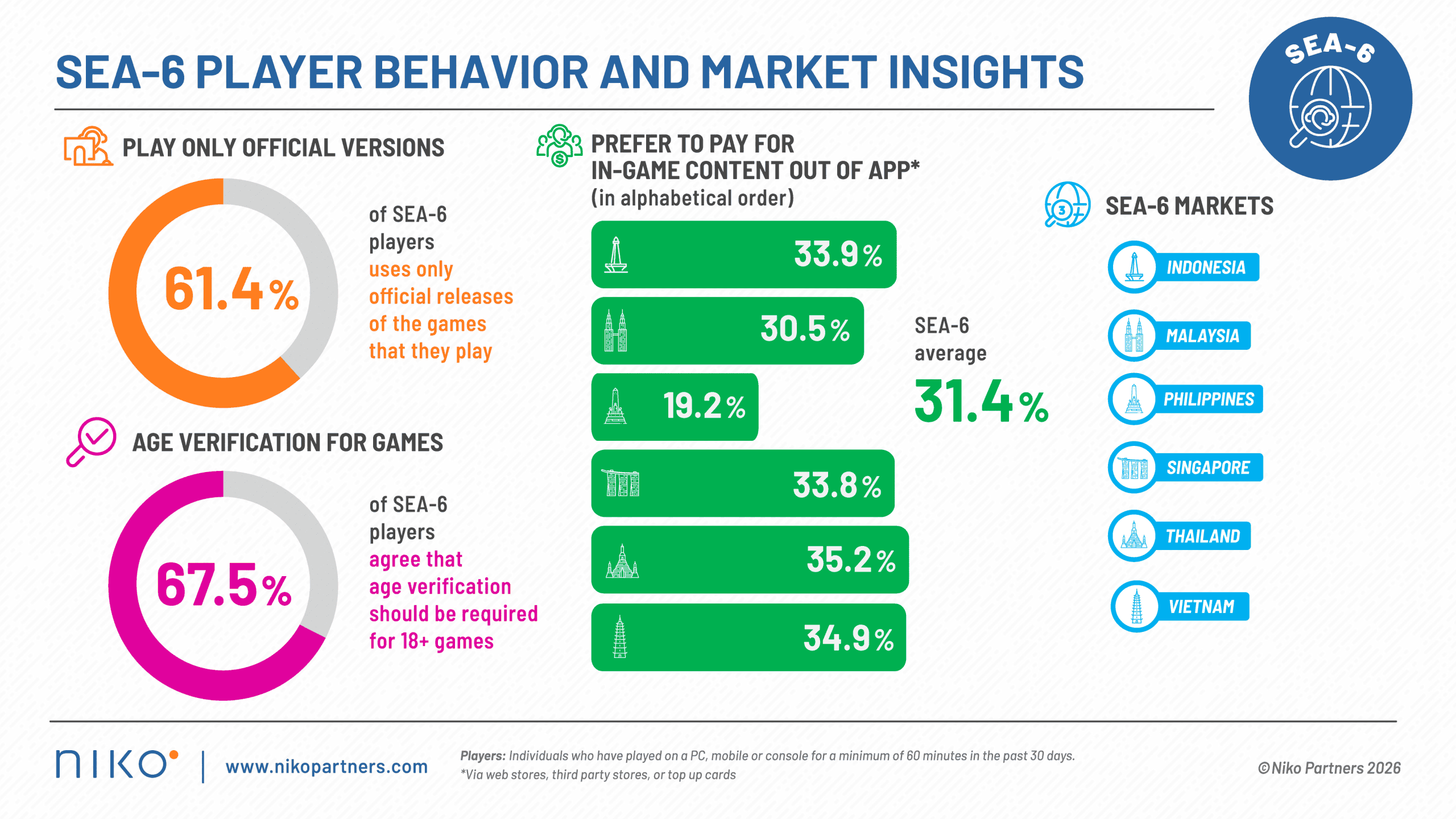
Video game markets in Southeast Asia are entering a new chapter of growth, driven by an expanding player base, increasing Learn more >

Note to Reader: This post offers a partial set of key takeaways from Niko’s 2026 Market Model Reports. Please fill out Learn more >
Niko Partners Vice President Xiaofeng Zeng reflected on his observations of ChinaJoy in this new blog post. Niko Partners has Learn more >
Video game markets in Southeast Asia are entering a new chapter of growth, driven by an expanding player base, increasing Learn more >
Note to Reader: This post offers a partial set of key takeaways from Niko’s 2026 Market Model Reports. Please fill out Learn more >